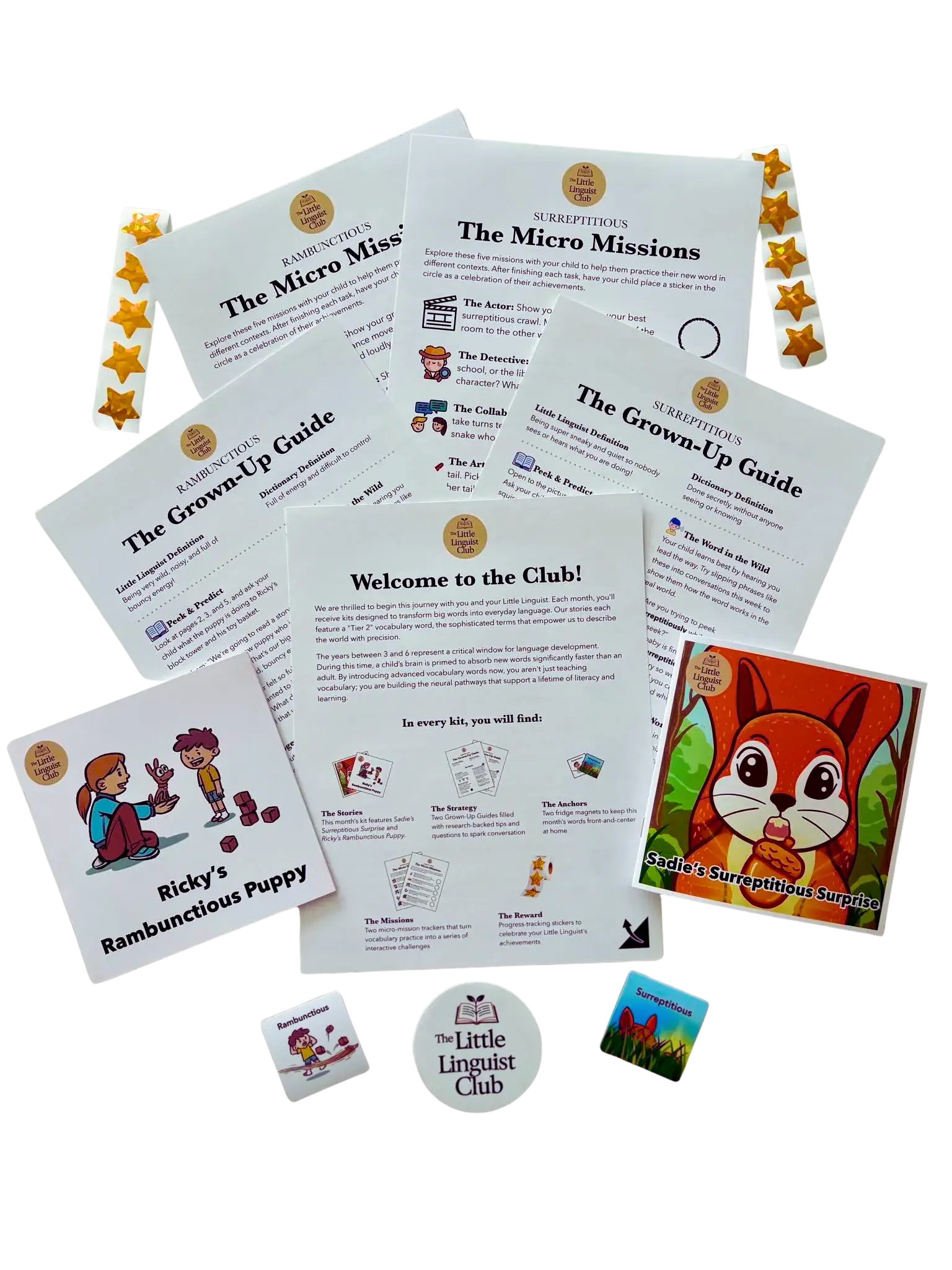
Meet the Kit
Our research-backed stories, guides, and hands-on activities make building a rich vocabulary a shared family adventure.
The Stories
Saddle-stitch story booklets, each featuring a big word in a meaningful context.
The Strategy
Grown-Up Guides filled with research-backed tips and questions to spark conversation.
The Anchors
Visual Anchor fridge magnets to keep your child's new words front-and-center at home.
The Missions
Micro-Mission Trackers that turn vocabulary practice into a series of interactive challenges.
The Reward
Progress-tracking stickers to celebrate every linguistic milestone.
A powerful vocabulary, naturally acquired.
No flashcards. No pressure. Just the confidence of a child who has the words to match their biggest dreams.
The Science of a Strong Start
Every Little Linguist Club kit is backed by research in developmental psychology and literacy science.
The Comprehension Engine
Research shows that a child's vocabulary starting at age 3 is a powerful predictor of their reading comprehension in 3rd grade and beyond1. By introducing Tier 2 vocabulary - those sophisticated words like resilient, inquisitive and versatile - during these essential years of language development, you are building the framework your child needs to thrive academically.
1Source: Hart & Risley (1995)
Supporting Artists
We believe in supporting the creative community, not AI companies. All stories feature original illustrations commissioned from independent artists.
100% Analog
Trade screen time for story time. We create a purely analog experience to protect those precious moments of human connection that apps and tablets simply can't replicate.
Purposeful Materials
No clutter or plastic trinkets that end up at the bottom of the toy box. All of our guides, trackers, and books are recyclable, and our magnets are designed for long-lasting use.
Future-Focused
1% of every purchase supports Stripe Climate in scaling technologies that capture CO2 and store it underground. We're proud to help build a cooler, cleaner, and healthier future for our kids.
What Parents Say
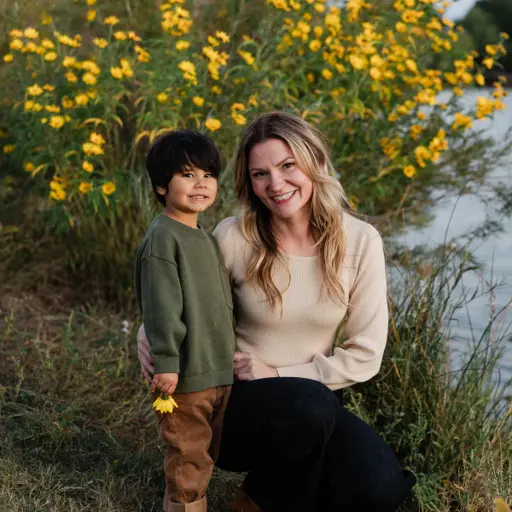
Rachel and her son
Meet the Founder
Designed by a Teacher.
Inspired by a Preschooler.
My journey in education began nearly two decades ago as a Teach For America corps member, an experience that led to my Master’s in Curriculum and Instruction. With a career spanning the K–12 spectrum, I’ve taught everything from elementary literacy to middle school English to AP Computer Science and SAT/ACT prep. In those years, I watched too many brilliant students struggle with the sophisticated vocabulary necessary for academic success. By the time they reached high school, memorizing vocabulary words felt like a chore rather than an empowering experience.
I eventually transitioned out of the classroom, but I remained fascinated by how children actually acquire language. I began a little experiment with my 3-year-old son: Instead of using a phrase like "the leaves are so pretty," I’d say "I love the nuanced colors of the leaves!" Instead of "there are so many dandelions in the yard," I'd say "those dandelions are just so pervasive!"
The impact of deliberately shifting from everyday words to precise, descriptive language became clear one day at preschool pickup. His teacher was eager to share a moment that had stopped her in her tracks. When a stack of papers accidentally scattered across the floor, my 3-year-old didn't miss a beat: "We'll just have to persevere and pick them up!" She was astounded, not just by his word choice, but by the casual confidence behind it. In that moment, I realized that sophisticated language can be acquired as naturally as a first word.
Today, I’m proud to share the Little Linguist Club with families looking to give their children the tools to become confident communicators, equipping every child with the vocabulary of a scholar before they even reach a classroom.
— Rachel Warbelow